
Papua New Guinea has existing substantial body of extractive-sector governance data that could help shape the country’s emerging Environmental, Social and Governance (ESG) reporting landscape.
PNGEITI Executive Director George Kauli told accounting and finance professionals in Lae on 28 August, 2026.
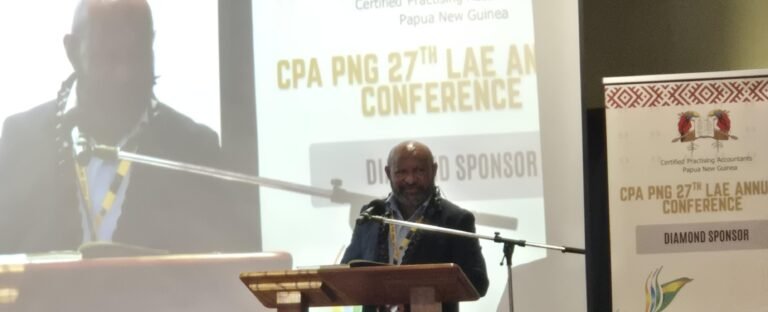
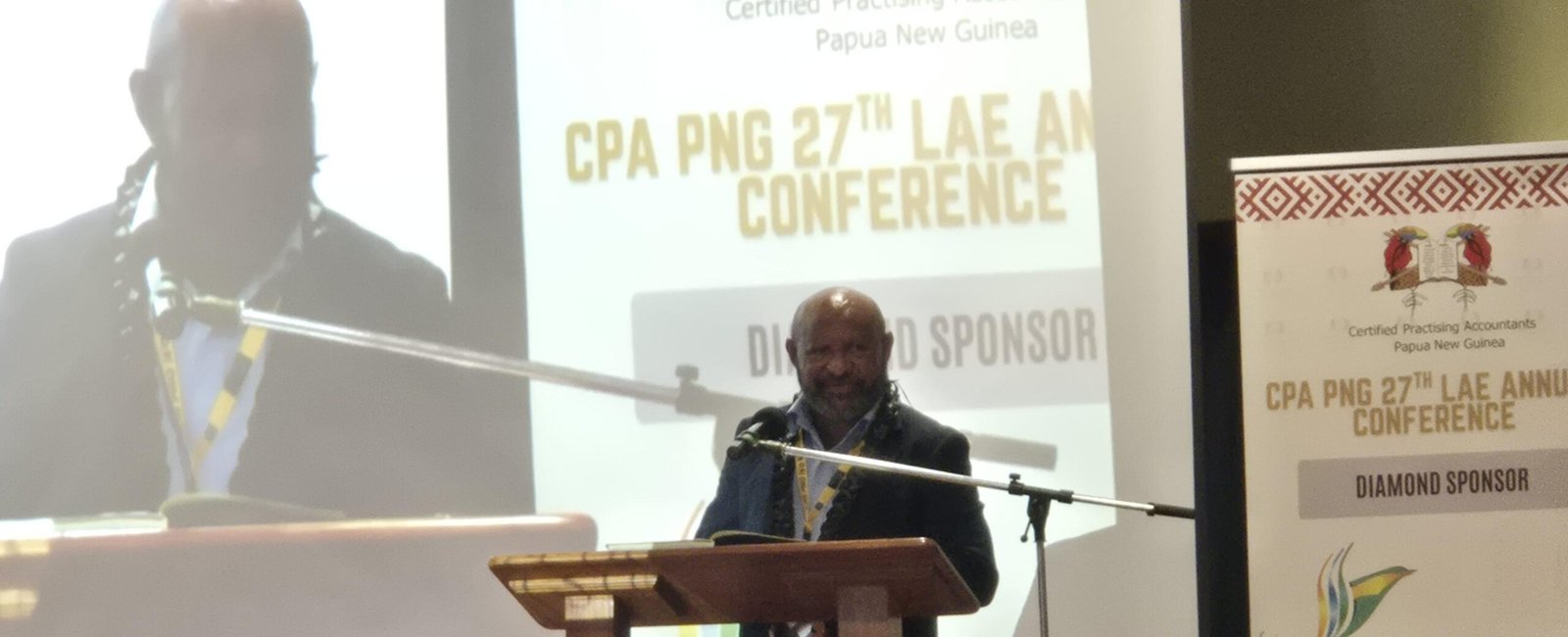
Mr Kauli who delivered a presentation titled “Bridging Transparency and Transformation: Integrating PNGEITI Data into National ESG Reporting Frameworks,” at the 2026 Certified Practising Accountant PNG (CPA PNG) in Lae, explained how information generated through the EITI process could contribute to stronger ESG reporting, bringing assurance and investment confidence in Papua New Guinea.
It was PNGEITI’s first presentation at a CPA PNG conference, opening a new avenue for engagement with the accounting and finance profession. Mr Kauli said the engagement was particularly important because accountants and finance professionals play a central role on how information is collected, verified, reported and ultimately used for decision-making.
Mr Kauli told participants that PNG does not necessarily need to start from scratch in developing the information base required for ESG reporting. Instead, the country has an opportunity to make better use of the credible governance data already being collected, reconciled and disclosed through PNGEITI.
Under the EITI Standard, reporting government agencies and extractive companies involved in PNG’s mining and oil and gas sectors disclose information across the extractive industry value chain. This includes contracts and licences, production and exports, government revenues, company payments, beneficial ownership, state participation and subnational payments and transfers, as well as social and environmental expenditures.
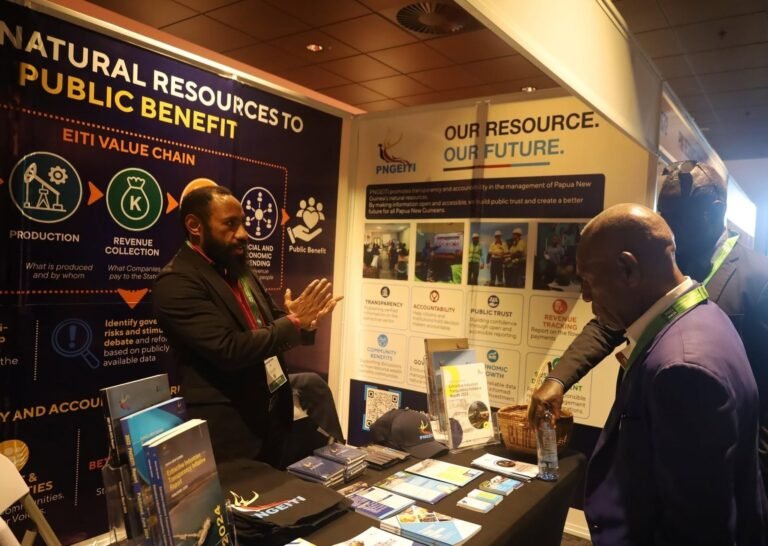
Mr Kauli explained that existing information provides a strong foundation for connecting transparency with ESG reporting, while potentially reducing duplication across reporting systems. The EITI value chain generates information from licensing and production through to revenue collection, allocation and the benefits received by communities. When these datasets are connected, they provide a more complete picture of how Papua New Guinea’s natural resources contribute to the economy and society.
He however, stressed that data is only valuable when it is reliable, comparable, transparent and capable of supporting sound decisions. This is where the relationship between EITI and ESG becomes particularly important.
Mr Kauli also emphasised that PNGEITI is more than an organisation that produces annual reports.
‘As Papua New Guinea’s national implementation of the Extractive Industries Transparency Initiative, PNGEITI collects information from reporting government agencies and extractive companies, reconciles payments and receipts, produces independently verified reports and publicly discloses the results. Its broader purpose is to improve transparency, strengthen accountability and support evidence-based policy-making.” He said.
Looking at the EITI value chain through an ESG lens, Mr Kauli identified significant areas of overlap. PNGEITI provides governance information on revenues, tax payments, beneficial ownership, contracts, state participation and subnational transfers, whilst capturing social information relating to community investments, local content and benefit sharing.
He clarified that PNGEITI is primarily a governance initiative and not an environmental reporting framework. He however, said the information generated through PNGEITI can contribute to all three ESG dimensions and provide a trusted governance-data foundation that complements wider ESG reporting.
Mr Kauli said ESG is increasingly influencing how investors assess companies, projects and jurisdictions. For PNG, he said the conversation should therefore go beyond whether companies are producing ESG reports and consider whether investors can trust the information they receive, whether resource revenues can be managed transparently, whether communities are benefiting and whether institutions have the capacity to produce reliable information.
“Investment follows confidence and confidence requires credible information,” Mr Kauli said.
“ For the accounting profession, one of the key messages was that the focus should not simply be on what data is available, but on how reliable that data is,” he said.
Mr Kauli highlighted several characteristics of PNGEITI data, including independent reconciliation, multi-stakeholder oversight, public disclosure and production according to an internationally recognised standard. He added that these principles are closely aligned with the work of accountants and assurance professionals, where the quality of a final report depends on the quality of underlying information, controls, verification processes and supporting evidence.
The presentation prompted a question from an accountant, who wanted to know if revenue data collected by PNGEITI is credible and can be relied upon in its reporting. Mr Kauli in response said PNGEITI does not simply accept information provided by extractive companies at face value. Instead, the EITI reporting process applies several layers of verification to establish the reliability of the information.
“The credibility of PNGEITI’s revenue data is supported by several layers of verification. Extractive companies provide financial and other relevant information for the specific financial year being reported and that information is subject to their own internal processes and controls, including internal audit processes,” Mr Kauli said.
He explained that PNGEITI further verifies company-reported information against records held by relevant government reporting agencies. For example, where an extractive company reports a specific amount of Corporate Income Tax paid for a particular financial year, PNGEITI compares and verifies the information against the corresponding records of the Internal Revenue Commission (IRC).
“We don’t just accept the information as reported by companies. We compare and verify it against the relevant government reporting agencies. For example, if a company reports a particular amount of Corporate Income Tax for a financial year, we verify that information with the Internal Revenue Commission,” he said.
Mr Kauli added that PNGEITI reporting extends beyond revenue data, covering production, exports and sales, subnational payments and transfers and other information across the extractive industry value chain. The information submitted by reporting entities is ultimately reconciled by the Independent Administrator, providing an additional independent layer to the overall reporting process. He also highlighted further steps PNGEITI is taking to strengthen assurance around government-reported data through the JICA-funded Revenue Management Project, in partnership with the Office of PNG Auditor-General (AGO).
“ Through the Agreed-Upon Procedures (AUP), PNGEITI is supporting an additional layer of verification around selected extractive revenue streams and government reporting processes. Unlike a financial audit, AUP involves specific procedures agreed between the relevant parties, with the practitioner reporting factual findings rather than providing an audit opinion,” he said.
The AUP initiative complements the existing PNGEITI reconciliation process and is intended to strengthen government assurance systems and confidence in the accuracy and reliability of extractive revenue reporting.
Mr Kauli also highlighted PNGEITI’s expanding work to strengthen transparency at the subnational level through its Subnational Awareness Roadshow, supported by the World Bank. The initiative engages provincial governments, local-level governments and landowner associations to improve understanding of extractive revenue flows and strengthen stakeholders’ ability to access, understand and use the information.
He further zeroed down on an important question many Papua New Guineans ask, not simply how much extractive revenue was collected nationally, but what happens to the revenue that was supposed to benefit their province, district, local-level government or community.
He said strengthening transparency at the subnational level is also important from an ESG perspective because the social impacts and benefits of extractive projects are ultimately experienced at the community and subnational level.
Looking ahead, Mr Kauli identified three opportunities for Papua New Guinea: recognising PNGEITI as a governance data source for national ESG reporting; strengthening collaboration between PNGEITI and the accounting profession; and developing national ESG assurance capability in areas such as data controls, verification and assurance methodologies.
He said the accounting profession, including CPA PNG, has an important role to play as ESG reporting develops, particularly through its expertise in controls, materiality, reporting systems, assurance and data quality.
In conclusion, Mr Kauli condensed his message into five words, Transparency. Trust. Investment. Opportunity. Transformation.
“Transparency provides reliable and accessible information. Reliable information builds trust. Trust creates confidence, and confidence supports investment. Investment, in turn, creates opportunities for jobs, infrastructure and inclusive development. Ultimately, these contribute to transformation,” he said.
Mr Kauli said PNGEITI already possesses a trusted foundation of governance data, but integrating that information into PNG’s broader ESG reporting landscape will require collaboration between government, industry, civil society and the accounting and finance profession.
PNGEITI’s first presentation at a CPA PNG conference has opened an important new avenue for engagement with the accounting and finance profession and expanded the conversation around how transparency data can support stronger governance, assurance and investment confidence.